Monday, 16 June 2014

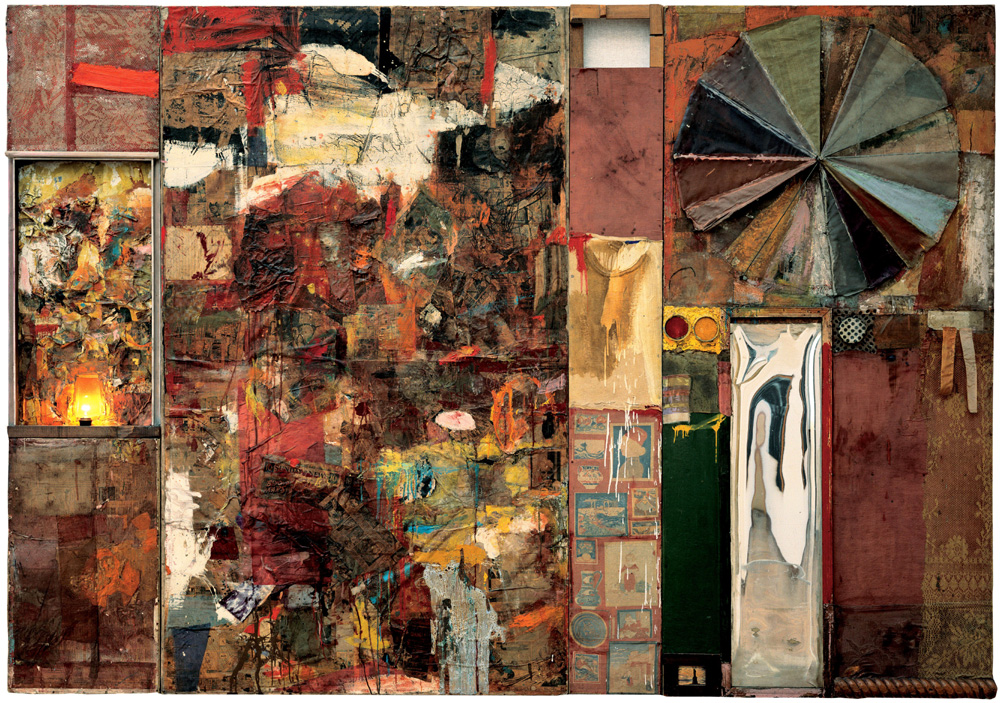
Robert Rauschenberg - assemblage

This is craaaazy! A sheep with a tyre round it's middle?! Though it's so strange that I do really like it!
I also really like this piece too as it really combines collage and that's what I love! I might have to try this next lesson.. to create something more abstract than my little alien creature!

Assemblage - my creature!

I created this alien..creature type thing in our 3D lesson last week and I just think he's so cute! I combined natural and man made objects to show a contrast between the two. I hadn't glued it all together at this point, but I will upload a picture of him glued as soon as I remember to take one as he has a few adaptions once glued...he was a bit unstable on his feet shall we say!

Monday, 9 June 2014

My initial assemblage..

Just attempted some assemblage.. not great but I shall attempt again! Maybe try spacing things out a little more, this reminds me too much of observationals from GCSE and A level art! D: I'd like to actually try and create either an animal or maybe even a distorted human form using clay or plaster along with found objects to make an actual sculpture! That would be exciting :D


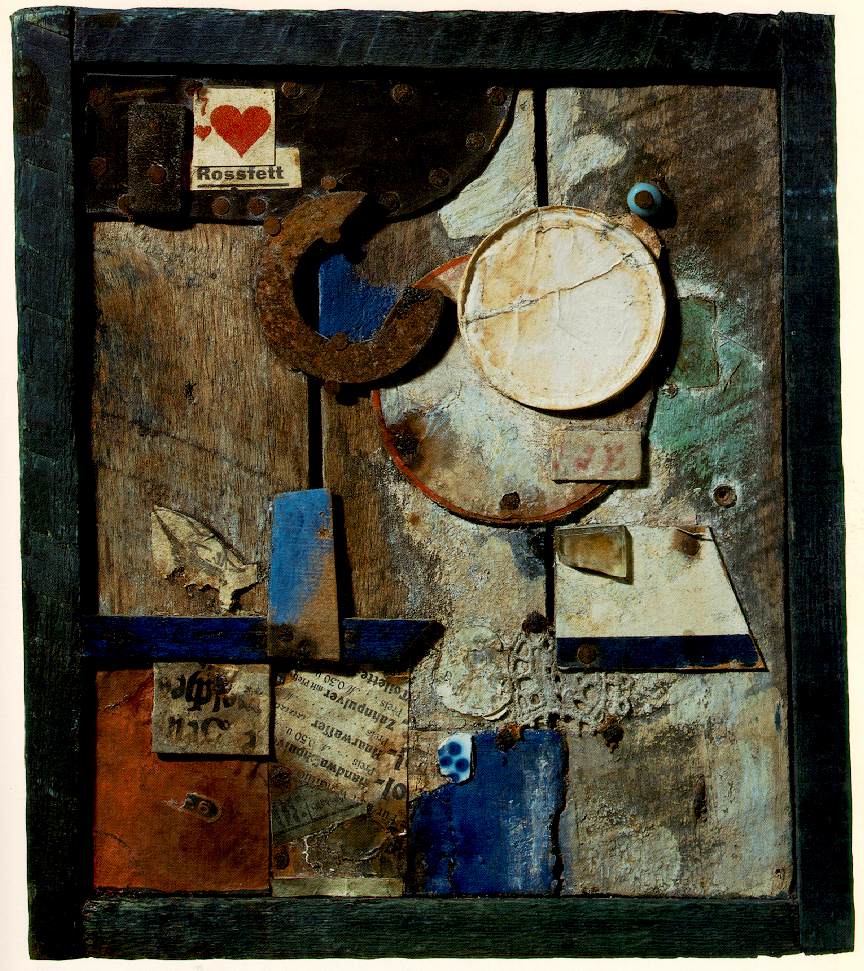
Assemblage - Kurt Schwitters

This is Kurt Schwitters' work - I really like it actually as the pieces in the work are a lot less distinguishable, you can't exactly tell what each little piece is. I also like this work because its like a collage and college is one of the mediums I love using in art, so it's sort of like a 3D collage. Rather than being whole objects, this is more like parts of things, broken objects, bits of rubbish rather than actual objects that have been found laying around. I also like the fact that it doesn't resemble anything!
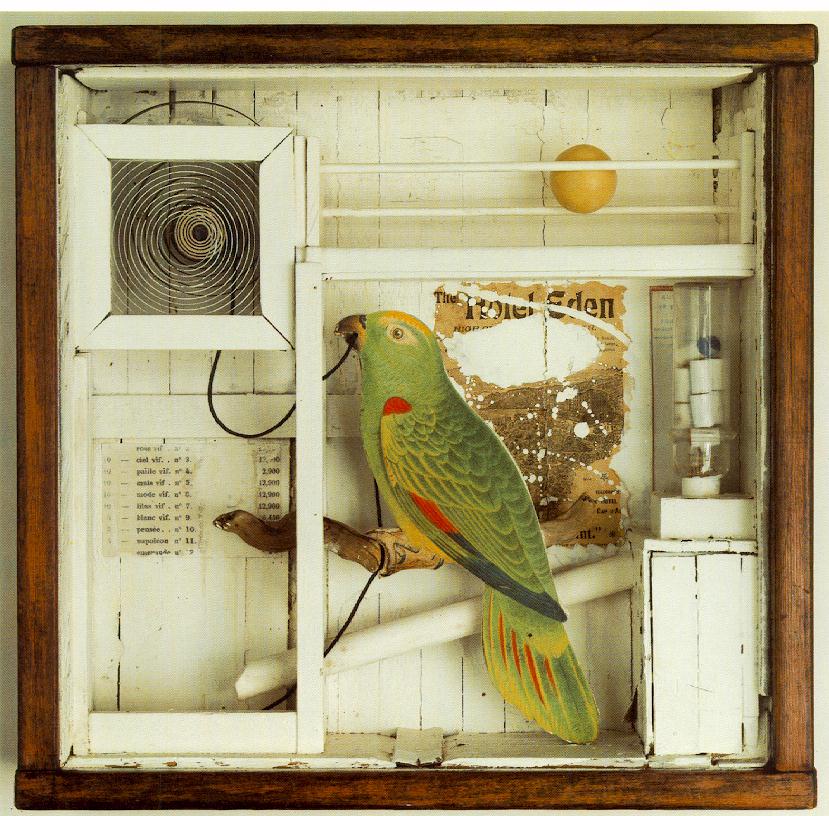
You can actually tell what these objects are, and this is totally different from the other piece above. Might try working like this too!

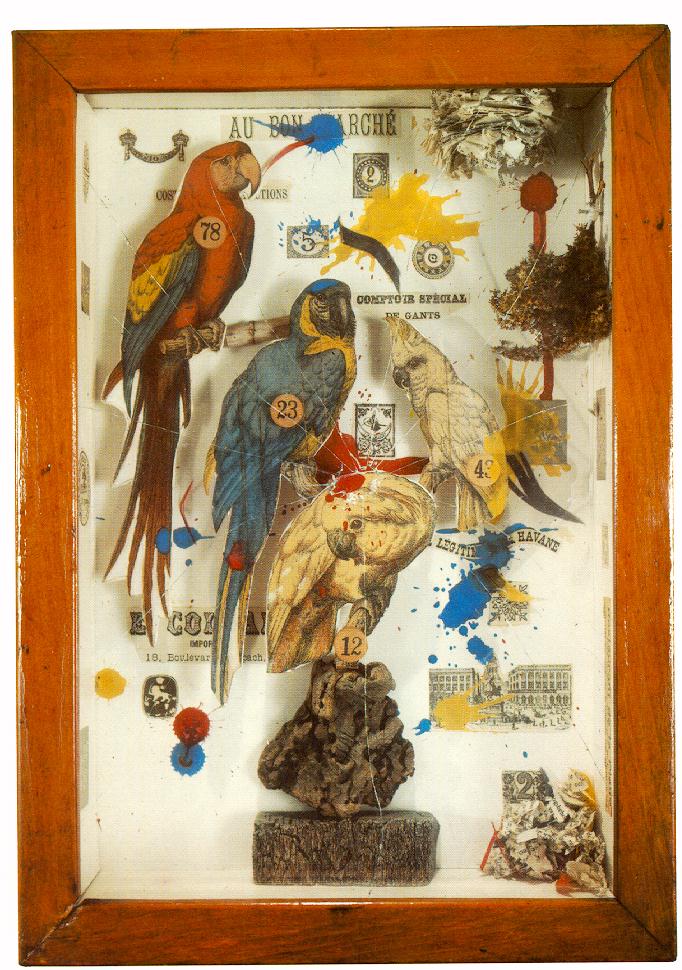
Assemblage - Joseph Cornell

I studied Joseph Cornell in year 10 / 11 as part of my GSCE coursework and found myself making wooden boxes to stash random artefacts in. Cheesily and childishly, my project was based on mythical creatures... and therefore, fairies! I used the fairy pictures that I had drawn in a similar way to how Joseph Cornell used birds. I recall from my secondary school research that Joseph Cornell used birds in his work as a way to express his emotions and feelings as he felt like a 'caged bird' and this was his outlet. He uses corks and small bottles quite a lot too and the birds are only images and not stuffed birds (thank god!)

Assemblage - Picasso

Pablo Picasso created some assemblage artwork along with his famous paintings so I am looking at his assemblage work. The above piece was created using the handlebars and the saddle of a bike. I like this as its so simple and instantly recognisable as a bull's head, but you have to look a little closer to realise what it's made from.

"The Goat (1950) It is easy to forget that Picasso was the first artist to incorporate real objects into his sculptures. As such, he was the forerunner of every modern piece of assemblage, every junk sculpture, every metal construction that contains a recycled iron fitting. He began experimenting in this way during the early Cubist period, but it was a life-long practice. The Goat, made when he was 69 years old, is one of his boldest and most vital three-dimensional constructions. During the war years Picasso had become adept at using the most unlikely materials and objects as the basis for sculptures. In 1950 he was living in Vallauris, in the south of France, with Francoise Gilot. His studio was close to a yard in which potters threw their discarded materials. Here he found a wicker basket used for the goat’s ribs, two ceramic jugs that formed the udders, and the palm fronds that define the face and spine. Other bits of metal were added to the mix and the entire piece unified with plaster. There is a lot of humour in this sculpture, and more than a hint of caricature. It is a mark of Picasso’s self-confidence that he was prepared to make such a work at a time when contemporary sculpture was preoccupied with lonely, anguished images of the human condition. For Picasso, the seriousness was all in the making, not the interpretations by others. From the beginning to the end he took risks that other artists simply could not conceive. The Goat bears witness to a bravura that could never be contained." - this is so interesting and I'd like to create something similar, sticking with the animals theme or possibly more into the human form.

Assemblage is found objects and items used to create sculptures so I'm now going to keep my eyes open for random objects that I can use as part of my sculpture.

Wikipedia definition of Assemblage

Wikipedia definition of assemblage:

Assemblage is an artistic process. In the visual arts, it consists of making three-dimensional or two-dimensional artistic compositions by putting together found objects. In literature, assemblage refers to a text "built primarily and explicitly from existing texts in order to solve a writing or communication problem in a new context". The origin of the artform dates to the cubist constructions of Pablo Picasso c. 1912-1914. The origin of the word (in its artistic sense) can be traced back to the early 1950s, when Jean Dubuffet created a series of collages of butterfly wings, which he titled assemblages d'empreintes. However, both Marcel Duchamp and Pablo Picasso had been working with found objects for many years prior to Dubuffet. They were not alone. Russian artist Vladimir Tatlin creates his "counter-reliefs" in the middle of the 1910s. Alongside Tatlin, the earliest woman artist to try her hand at assemblage was Elsa von Freytag-Loringhoven, the Dada Baroness. In addition, one of the earliest and most prolific was Louise Nevelson, who began creating her sculptures from found pieces of wood in the late 1930s.
In 1961, the exhibition "The Art of Assemblage" was featured at the New York Museum of Modern Art. The exhibition showcased the work of early 20th-century European artists such as Braque, Dubuffet, Marcel Duchamp, Picasso, and Kurt Schwitters alongside Americans Man Ray, Joseph Cornell, Robert Mallary and Robert Rauschenberg, and also included less well known American West Coast assemblage artists such as George Herms, Bruce Conner and Edward Kienholz. William C Seitz, the curator of the exhibition, described assemblages as being made up of preformed natural or manufactured materials, objects, or fragments not intended as art materials.